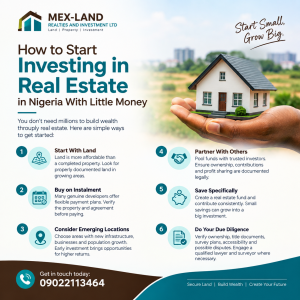

Land Investment in Nigeria | Land Banking | Buying Land for Investment | Real Estate Investment in Nigeria
Imagine buying a plot of land today for ₦3 million and, several years later, discovering that the same land is worth ₦10 million, ₦15 million or even more.
That is the basic idea behind land banking.
But here is the part many people get wrong:
Land banking is not simply buying cheap land and waiting.
The real skill is knowing where to buy, when to buy, what to verify and why the area is likely to attract future demand.
For investors looking for a relatively simple way to enter the Nigerian real estate market, land banking can be an attractive long-term strategy. However, the location, title, purchase price, development prospects and exit strategy all matter.
In this article, I will explain what land banking means, why it can be profitable in Nigeria, the risks involved and how you can start investing in land intelligently.
What Is Land Banking?
Land banking is the practice of buying undeveloped or underdeveloped land in an area with potential for future growth and holding it until demand and land values increase.
Unlike rental property, where an investor may receive monthly rental income, land banking generally focuses on capital appreciation.
For example:
You buy a plot today for ₦3 million.
You hold it for five years.
During that period, roads improve, houses and businesses move into the area, population increases and demand for land grows.
If comparable land in the area is now selling for ₦8 million, your asset has potentially appreciated substantially.
The important question, therefore, is not simply:
Is the land cheap?
The better question is:
Why should this land become more valuable in the future?
intelligent land investment from speculation.
Why Is Land Banking Attractive in Nigeria?
Nigeria has expanding cities, growing populations and continuous demand for residential, commercial and industrial space.
As cities expand outward, areas that were once considered remote can gradually become integrated into the urban environment.
This creates opportunities for investors who identify promising locations early.
However, appreciation is not automatic. Land values can increase when there are genuine demand drivers such as population growth, improved accessibility, employment centres, infrastructure and new developments.
Here are some of the reasons investors consider land banking.
1. You Can Start With a Single Plot
You do not necessarily need to own a large estate to participate in land investment.
Depending on location and market conditions, an investor can begin with one plot and gradually build a portfolio.
The objective can be to acquire strategically rather than simply accumulating as much land as possible.
2. Land Does Not Require the Same Maintenance as a Building
A completed property can require:
- Repairs
- Painting
- Plumbing
- Electrical maintenance
- Tenant management
- Security
- Property management
Raw land generally does not require the same level of ongoing physical maintenance.
That does not mean owning land has no costs. Documentation, taxes or ground rent where applicable, security, fencing, estate levies and other obligations may still arise. The Federal Ministry of Housing and Urban Development, for example, notes that ground-rent obligations can apply to federally owned lands.
3. You Can Benefit From Early Entry Into Growing Locations
One of the most interesting aspects of land banking is timing.
Consider two investors.
Investor A buys land after an area has already become fully developed and highly demanded.
Investor B identifies the same growth corridor years earlier and buys before prices rise significantly.
Both may eventually own property in the same general area, but their acquisition prices can be dramatically different.
This is why experienced investors pay attention to growth corridors, not just today’s property prices.
4. Infrastructure Can Influence Land Values
Roads, bridges, schools, shopping centres, industrial developments, estates and other infrastructure can influence how attractive an area becomes.
But investors should be careful.
There is a huge difference between:
“A road is being constructed here.”
and
“Someone said a road will eventually be constructed here.”
Never base a major investment decision solely on an unverified development promise.
Research the project, its status, location and realistic timeline.
5. Land Can Have Multiple Exit Strategies
A land investor may eventually decide to:
- Sell the land outright
- Sell after appreciation
- Develop it
- Build and sell
- Build and rent
- Use it for agricultural purposes where appropriate
- Hold it as part of a long-term property portfolio
Your strategy should be determined before buying.
The Most Important Principle: Buy the Future, Not Just the Land
This is one of the biggest lessons in land banking.
A piece of land may be cheap because nobody wants it.
Another piece may be relatively affordable because the area is still developing.
Those are two completely different situations.
Before buying, ask:
Why would people want this location five or ten years from now?
Look for evidence such as:
- Expanding residential development
- Population growth
- New roads and improved accessibility
- Nearby commercial activity
- Schools and healthcare facilities
- Industrial developments
- Existing estates
- Growing employment opportunities
- Proximity to established communities
- Increasing demand for housing
The goal is to identify real demand drivers rather than simply believing a salesperson’s prediction.
How to Start Land Banking in Nigeria
If you are considering buying land for investment, don’t rush straight to payment.
Use a process.
Step 1: Determine Your Investment Budget
Know exactly how much you can comfortably invest.
Don’t put every naira you have into land simply because you believe prices will increase.
Remember that you may also have additional expenses such as:
- Legal fees
- Survey
- Documentation
- Registration
- Development levies
- Estate charges
- Fencing
- Taxes or applicable statutory charges
Your actual acquisition cost is therefore more than the advertised price of the plot.
Step 2. Choose the location carefully
Location is one of the most important factors in land investment.
Don’t buy simply because someone tells you:
This place will soon become the next Lekki.
ask for evidence.
Study the surrounding area.
Look at existing development.
Check accessibility.
Find out what is happening around the location.
Most importantly, understand who will eventually buy or use the land.
If there is no realistic source of future demand, appreciation may take much longer than expected.
Step 3: Investigate the Land Before Paying
This is where many investors make expensive mistakes.
A beautiful location and attractive price mean very little if the title is defective.
Before purchasing land, investigate:
- Who owns the land?
- How did the seller acquire it?
- What title documents exist?
- Is there any government acquisition?
- Is the property subject to litigation?
- Has the land been sold previously?
- Are there competing claims?
- Does the survey correspond with the physical location?
- Are there restrictions affecting the property?
Recent Nigerian legal guidance continues to emphasise independent title verification, physical inspection and appropriate searches before committing substantial funds.
Do not rely solely on documents handed to you by the seller.
Documents should be independently verified.
Step 4: Inspect the Physical Land
Never buy land based entirely on:
- WhatsApp pictures
- A video
- Google Maps
- An agent’s description
- A brochure
Visit the property or have a trusted professional inspect it.
Check the boundaries.
Look at the surrounding development.
Observe access roads.
Talk to people familiar with the area where appropriate.
A registered surveyor can also help establish whether the physical land corresponds with the survey information.
Physical inspection is an important part of protecting yourself against buying the wrong property or discovering problems after payment.
Step 5: Engage the Right Professionals
One of the most expensive mistakes a property buyer can make is trying to save a little money by avoiding professional verification.
Depending on the transaction, you may need the services of:
A property lawyer — for legal/title investigation and transaction documentation.
A registered surveyor — for survey, boundaries and identification of the land.
A trusted real estate professional — for market information, location analysis and transaction guidance.
Professional fees are an expense.
But losing millions of naira because you bought problematic land can be far more expensive.
Step 6: Understand the Title
Don’t be impressed simply because someone says:
It has C of O
A title document needs to be investigated in context.
Depending on the property and jurisdiction, documents and interests may include instruments such as:
- Certificate of Occupancy
- Deed of Assignment
- Governor’s Consent
- Survey Plan
- Registered title
- Allocation documents
- Other relevant customary or statutory documents
A Certificate of Occupancy, for example, does not mean that a buyer should automatically skip independent investigation. Current legal guidance specifically warns that title documents must be verified and that issues such as litigation, competing claims and encumbrances may still need to be investigated.
Step 7: Don’t Buy Because of Pressure
This is extremely important.
If someone tells you:
Pay today or the price will increase tomorrow
Stop.
Do your investigation first.
A genuine investment opportunity should survive reasonable due diligence.
You would rather lose an opportunity than lose your money.
As recent Nigerian property guidance puts it, proper due diligence should come before substantial payment, not after.
How Much Money Do You Need to Start Land Banking?
There is no universal minimum amount.
Land prices vary significantly depending on:
- State
- City
- Location
- Title
- Accessibility
- Infrastructure
- Demand
- Plot size
- Development level
- Estate facilities
The important thing is not necessarily to start with a huge amount.
You can begin by identifying an investment amount that fits your finances and then searching for legitimate land within that range.
Don’t stretch yourself financially simply because you are afraid that land prices will increase.
How Long Should You Hold Land?
Land banking is generally a long-term strategy.
It may take years for an emerging location to mature.
Some locations appreciate relatively quickly because of rapid development.
Others may take much longer.
Therefore, don’t buy land today expecting to automatically double your money next year.
There is no guaranteed appreciation period.
A responsible investor should have a realistic holding period and understand that land can also be difficult to sell quickly if demand is weak.
The Biggest Mistakes to Avoid When Buying Land in Nigeria
❌ Buying because the land is cheap
Cheap does not automatically mean profitable.
❌ Buying without verifying title
A beautiful location cannot compensate for defective ownership.
❌ Buying based on promises of future infrastructure
Verify proposed developments independently.
❌ Paying before due diligence
Investigate first. Pay afterwards.
❌ Ignoring the survey
The land you are shown should correspond with the land described in the relevant survey documentation.
❌ Assuming C of O means everything is fine
Title documents still require appropriate verification.
❌ Investing all your money
Land banking is not a reason to put your entire financial life at risk.
❌ Expecting guaranteed returns
Real estate values can rise, stagnate or even fall depending on market conditions and location.
Is Land Banking Better Than Buying a House?
They serve different investment purposes.
A rental property may potentially provide ongoing rental income, while land banking primarily targets future capital appreciation.
A building can also appreciate, but it comes with maintenance and management responsibilities.
Land may be simpler to hold, but it generally does not produce rental income while you wait.
Therefore, the right choice depends on your:
- Budget
- Investment objective
- Risk tolerance
- Time horizon
- Need for cash flow
- Preferred exit strategy
The question shouldn’t simply be:
“Which is better?”
Instead ask:
“Which investment matches my financial objective?”
How to Identify Good Land for Investment in Nigeria
Before buying, score the opportunity against these questions:
1. Is the location developing?
2. Is there genuine demand?
3. Is accessibility improving?
4. Are people already building around the area?
5. Are there credible economic activities nearby?
6. Is the asking price reasonable compared with comparable properties?
7. Is the title verifiable?
8. Is the land free from problematic acquisition or competing claims?
9. Can I realistically resell it in the future?
10. What happens if development takes longer than expected?
If you cannot answer these questions, don’t rush to pay.
Land Banking Is About Patience
One of the biggest advantages of land banking can also be its biggest challenge:
You have to wait.
People often want investments that produce immediate results.
Land banking doesn’t necessarily work that way.
You may buy land today, hold it, watch development gradually move towards the area and eventually benefit from increased demand.
The investor who understands this is less likely to make emotional decisions.
How I Can Help You Find Land for Investment in Nigeria
If you are looking for land to buy for investment, future development, resale or long-term wealth creation, don’t just buy the first plot someone recommends to you.
You need to understand:
The location.
The title.
The price.
The development potential.
The risks.
And your exit strategy.
As a real estate professional, I help prospective property buyers identify and acquire land and other properties while providing guidance through the buying process.
Whether you are a first-time investor, an experienced property investor or a Nigerian in the diaspora looking to invest back home, you can contact me to discuss available land opportunities and determine what may fit your investment objective.
Looking for Land to Buy in Nigeria?
Don’t just buy land. Buy strategically.
If you’re ready to explore available land investment opportunities, contact Nnaemeka Anselm for available properties, location details, pricing and guidance on the next steps.
Your first plot of land could be the beginning of your real estate portfolio.
Frequently Asked Questions About Land Banking in Nigeria
What is land banking in Nigeria?
Land banking is the strategy of buying undeveloped or underdeveloped land in an area with potential for future growth and holding it with the expectation that its value may appreciate over time.
Is land banking profitable in Nigeria?
Land banking can be profitable when an investor purchases suitable land at a reasonable price in a location with genuine long-term demand and development potential. However, appreciation is not guaranteed.
How much money do I need to start investing in land?
There is no fixed amount. Land prices vary significantly by location, title, size and level of development. Investors should establish a realistic budget and consider additional transaction and holding costs.
What should I check before buying land in Nigeria?
You should investigate ownership, title documents, survey information, government acquisition, litigation, competing claims, physical boundaries, accessibility and other relevant legal and planning issues before paying.
Can I buy land and sell it later for profit?
Yes. This is one possible land-banking strategy. However, the eventual selling price depends on market demand, location, development and other factors. There is no guaranteed profit.
Is land banking good for beginners?
It can be an entry point into real estate, but beginners should not treat it as risk-free. Proper research and professional due diligence are particularly important for first-time buyers.
Should I buy land in a developing area?
A developing area can offer potential for appreciation, but development alone does not guarantee returns. Investigate the reasons for the area’s growth, the quality of infrastructure, demand and the legal status of the property.
Final Thoughts
Land banking is not about guessing which location will become expensive.
It is about identifying real growth potential before the market fully prices it in, conducting proper due diligence and having the patience to hold.
The most important lesson is simple:
Don’t buy land because someone says it will appreciate. Buy only after you understand why it could appreciate and have verified what you are actually buying.
Nigeria’s real estate market continues to create opportunities, but smart investors understand that the foundation of every successful land investment is not the promise of profit—it is proper research, sound documentation, strategic location and disciplined decision-making.
If you’re ready to buy land in Nigeria for investment, contact me today and let’s discuss available opportunities that match your budget and investment goals.
Nnaemeka Anselm
09022113464